Red socks, billiards, dreams, bebop - and a very late arrival at Carnegie Hall.
Django Reinhardt is remembered as one of the most original guitarists in jazz history. His recordings with Stéphane Grappelli changed the role of the guitar in European jazz, and the sound he helped create is still played around the world almost a century later.
But the musician is only half of the story.
The people who knew Django remembered someone who could be elegant and unpredictable, intensely serious about music and completely uninterested in schedules. He loved billiards, fishing, gambling and painting. He could disappear when he was expected at a recording session, arrive at an important engagement without a guitar, and combine formal evening clothes with bright red socks simply because he thought the colours looked good together.
Some stories about Django have inevitably grown in the telling. Others come directly from people such as Stéphane Grappelli and Charles Delaunay, who worked and travelled with him for years.
Together they reveal something recordings alone cannot: what Django Reinhardt was like when he put the guitar down.
A fire that should have ended his career
Django's most extraordinary story happened before most of the world had heard his name.
In 1928, at the age of eighteen, he was badly burned in a fire in the caravan where he lived. His left hand was seriously injured, leaving the ring finger and little finger with severely restricted movement.
For a guitarist, it looked catastrophic.
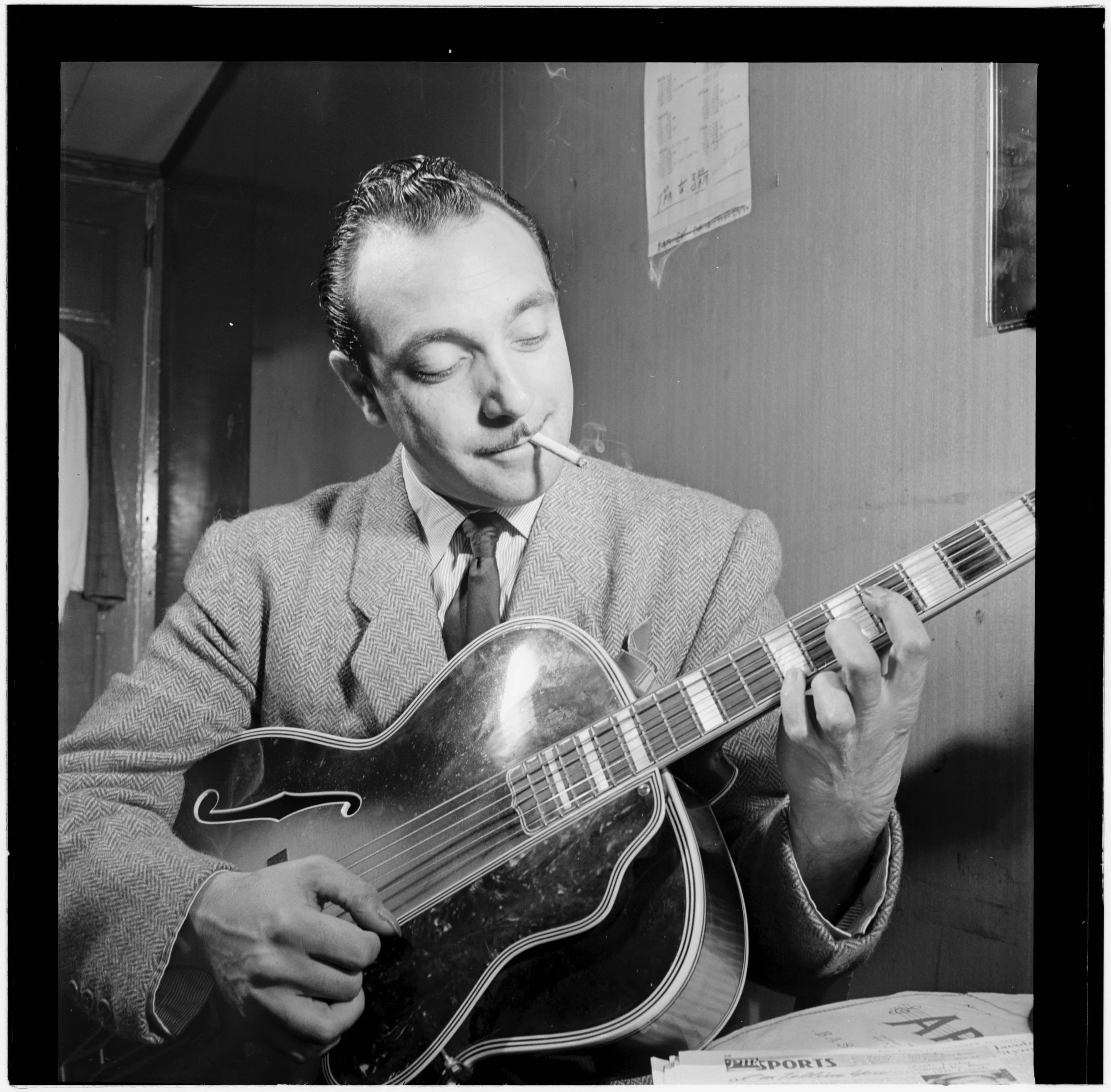
During a long recovery Django effectively rebuilt his technique around the fingers he could still use. His melodic playing came to rely largely on his index and middle fingers, while he found other ways to make limited use of the injured fingers, particularly in chord shapes.
It is tempting to describe the injury as the source of Django's style, but that goes too far. His musical imagination was his own. What the injury demonstrates is his astonishing ability to adapt.
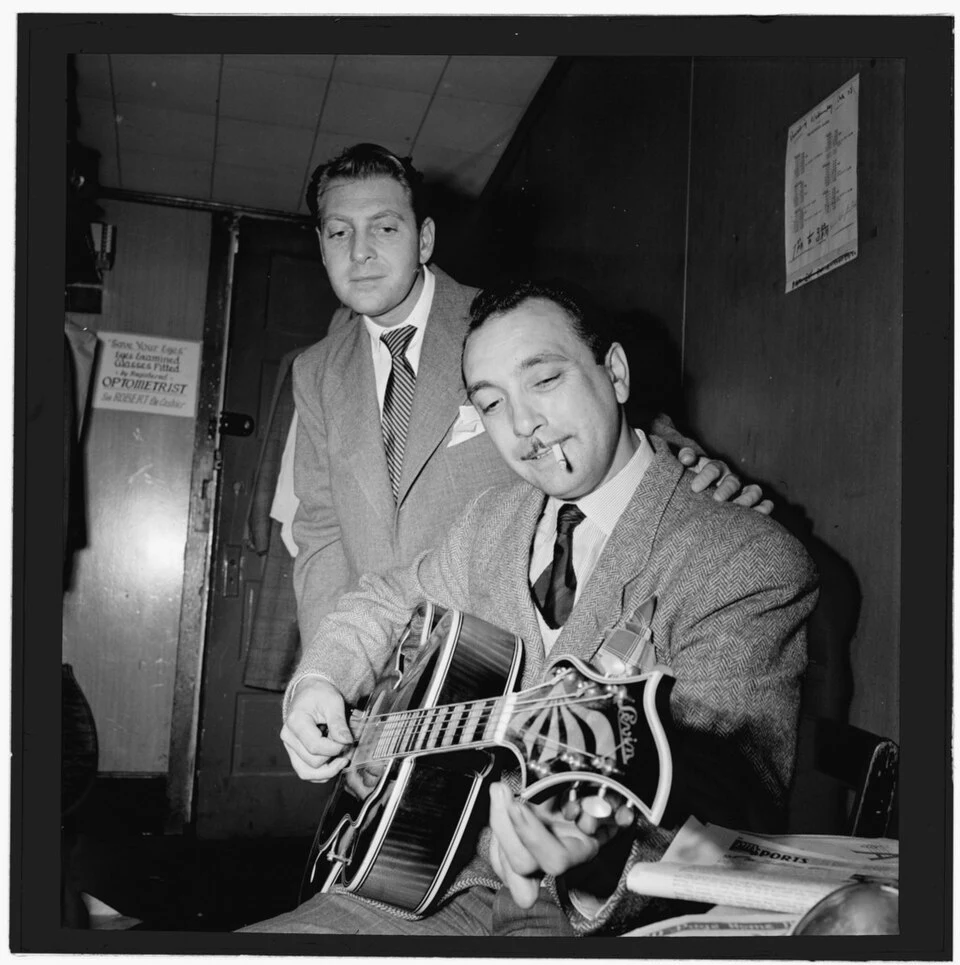
Years later, photographer William P. Gottlieb captured Django's fretting hand in remarkable detail during his 1946 visit to New York.
He couldn't read music - but that did not stop him composing it
Django had very little formal education and did not read conventional musical notation.
That fact becomes much more interesting when we stop interpreting it as a limitation.
Django could conceive music considerably larger than a guitar solo. When he needed ideas written down, another musician could transcribe what he played or dictated. During the 1940s, clarinettist Gérard Lévêque helped put some of those musical ideas onto paper.
His approach was therefore almost the reverse of a conservatory composer's:
That also makes one particular Django composition considerably more intriguing.
Manoir de mes rêves may literally have begun in a dream
According to bassist Emmanuel Soudieux, Django spoke about a dream in which he found himself inside a great manor and heard the sound of an organ.
The dream became associated with the melody he called Manoir de mes rêves - The Manor of My Dreams.
The idea apparently extended beyond the familiar jazz composition. Django envisioned something more ambitious, involving larger orchestral forces, while Gérard Lévêque attempted to transcribe the music Django played to him.
The larger work was never completed.
Django also painted, and a painting associated with the same title survives in accounts of his artistic life.
There is something wonderfully characteristic about that: a melody heard in a dream becoming music, perhaps the beginning of a larger composition, and an image as well.
And yes - there really were the red socks
Stéphane Grappelli remembered the first time Django appeared in formal evening dress.
The outfit was completed by a pair of bright red socks.
His companions tried to explain, carefully, that this was not normally how evening dress worked.
Django disagreed.
He liked the combination because red looked good with black.
It is one of those tiny details that tells us far more about a person than a list of dates ever could.
Grappelli also recalled Django entering social situations whose rules were completely unfamiliar to him. One often-repeated story places him dining with Belgian royalty, eating lettuce with his fingers - yet doing it with such natural assurance that Grappelli felt he somehow carried it off anyway.
The sophistication people heard in Django's music did not come from adopting the social rules of the circles into which fame carried him.
He remained very much himself.
Gangster films, wide hats - and a monkey
Django apparently loved American gangster films.
Several biographical accounts connect that enthusiasm with his taste for broad-brimmed hats, worn at an angle over one eye.
And then there is the monkey.
Yes, accounts of Django's life mention that he kept a pet monkey for a period.
Recollections from people around him also describe his superstitious side, his fascination with games and his remarkable skill at billiards.
The individual details are amusing, but together they produce a recognisable portrait: Django was intensely curious, impulsive and capable of becoming completely absorbed by whatever happened to interest him at that moment.
Sometimes that was music.
Sometimes it definitely was not.
Billiards could be serious business
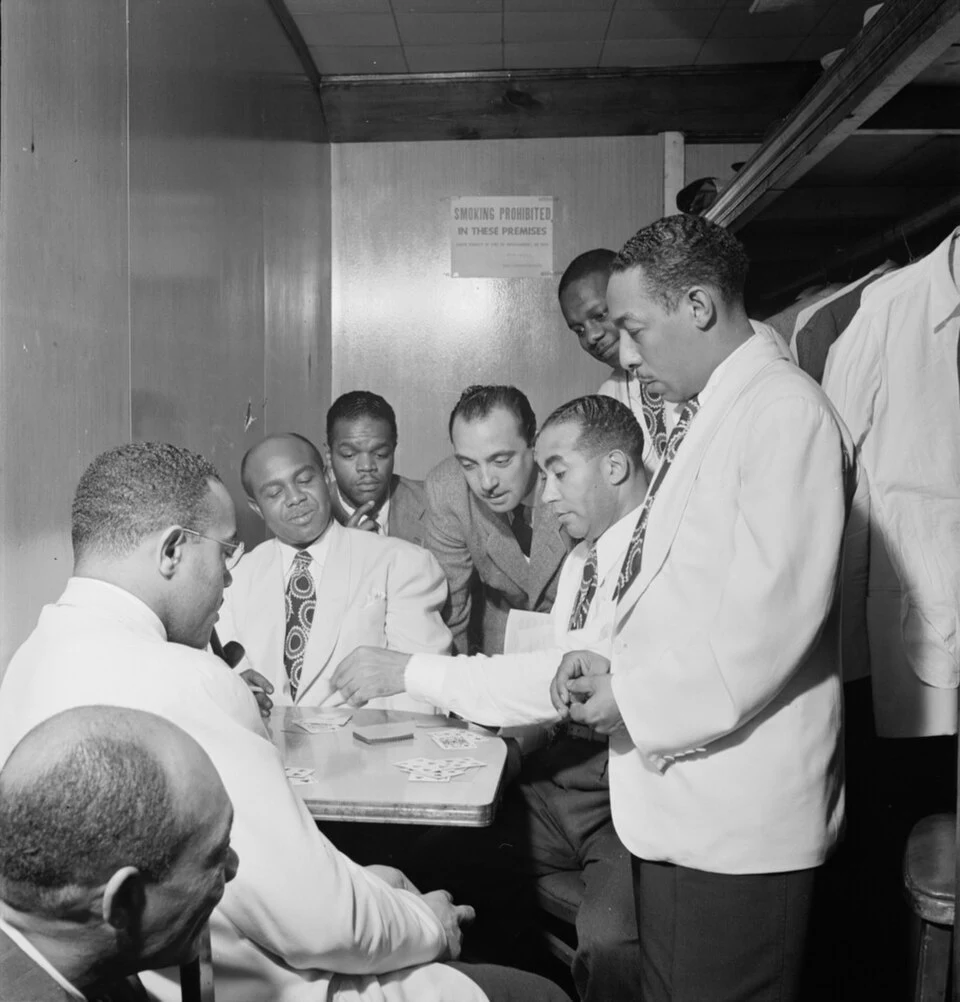
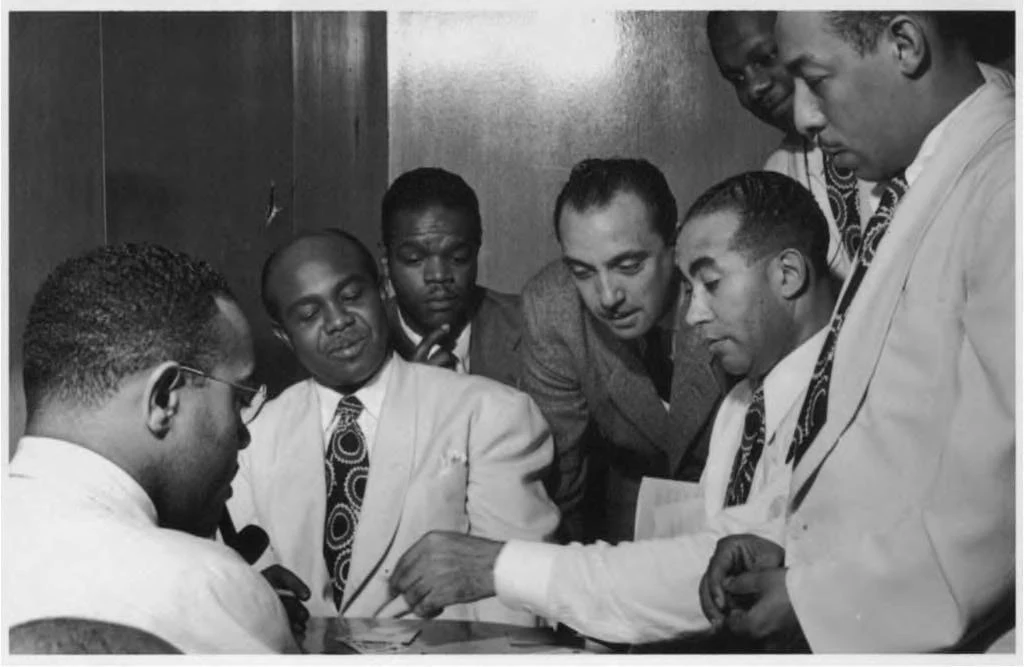
If Django had devoted to schedules the attention he devoted to billiards, life would have been considerably easier for his managers.
Accounts from friends repeatedly mention his love of games and gambling. He was particularly skilled at billiards, and later in life, when he settled in Samois-sur-Seine, playing billiards and fishing became regular parts of his life.
Django could also simply disappear.
Friends, organisers and fellow musicians might expect him at a rehearsal or recording session while Django had found something else that interested him more. Stories of people tracking him down in billiard halls, by the river or elsewhere recur throughout the recollections of those who worked with him.
Charles Delaunay remembered Django as someone who loved being near water and fishing. Accounts even describe him catching trout with his hands between the rocks.
It would be easy to describe this behaviour simply as laziness.
It probably makes more sense to recognise that Django did not appear to regard the machinery of a professional musical career with the same reverence as everybody trying to organise it for him.
The day Andrés Segovia asked for the sheet music
One of the best-known Django stories concerns the great Spanish classical guitarist Andrés Segovia.
Versions differ in their smaller details, so those are best treated cautiously. The core of the story, however, appears repeatedly in accounts of Django's life.
Django played for Segovia.
Segovia was impressed enough to ask about obtaining the written music for what he had just heard.
There was a problem.
Whether every line of dialogue later attached to the story happened exactly as remembered is less important than what made the story worth preserving in the first place.
The two guitarists represented almost opposite musical traditions.
Segovia's world was built around a written classical repertoire.
Django's music could exist completely in the instant of performance.
And for a few minutes those worlds met.
During the Occupation, Nuages was everywhere
The Second World War split the original Quintette du Hot Club de France.
Stéphane Grappelli remained in Britain while Django returned to France. In Paris he formed a new group, replacing the violin with clarinet - most famously Hubert Rostaing.
This period produced one of Django's greatest compositions.
The piece became one of the great popular successes of wartime Paris and is inseparably associated with this period of Django's career.
Later retellings sometimes call it an unofficial anthem of occupied Paris or of hope for liberation. That wording is better understood as retrospective symbolism rather than an official status.
What is clear is that the melody became extraordinarily popular.
For a man whose personality could appear restless and unpredictable, Nuages is almost its opposite: patient, restrained and unforgettable.
Then Duke Ellington invited him to America
In 1946 Django finally reached the country whose jazz musicians had inspired him for years.
And he went there with Duke Ellington.
Ellington brought him on tour as a featured guest soloist with his orchestra. The tour passed through major American cities before reaching New York and Carnegie Hall.
There was just one unusual detail.
Photographer William P. Gottlieb's contemporary notes confirm that Django had arrived without an instrument of his own. For Gottlieb's photography session, a guitar belonging to Ellington guitarist Fred Guy was supplied.
Later accounts suggest that Django expected American guitar manufacturers to be eager to provide him with an instrument once he arrived.
Reality was less obliging.
Used to his acoustic Selmer, Django also found himself working with amplified American guitars in large concert halls - another adjustment during a trip that seems to have been exciting, frustrating and bewildering in roughly equal measure.
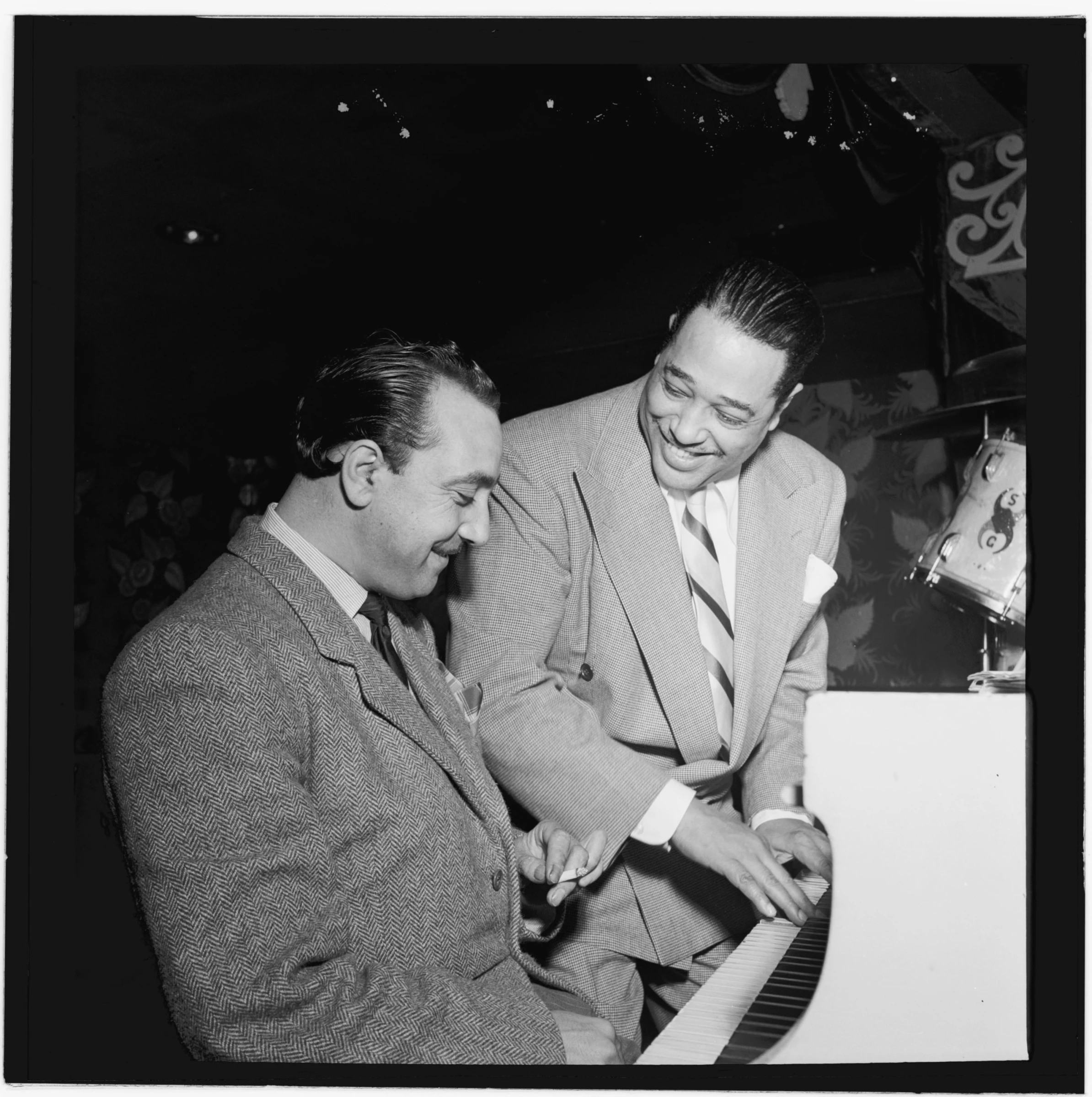
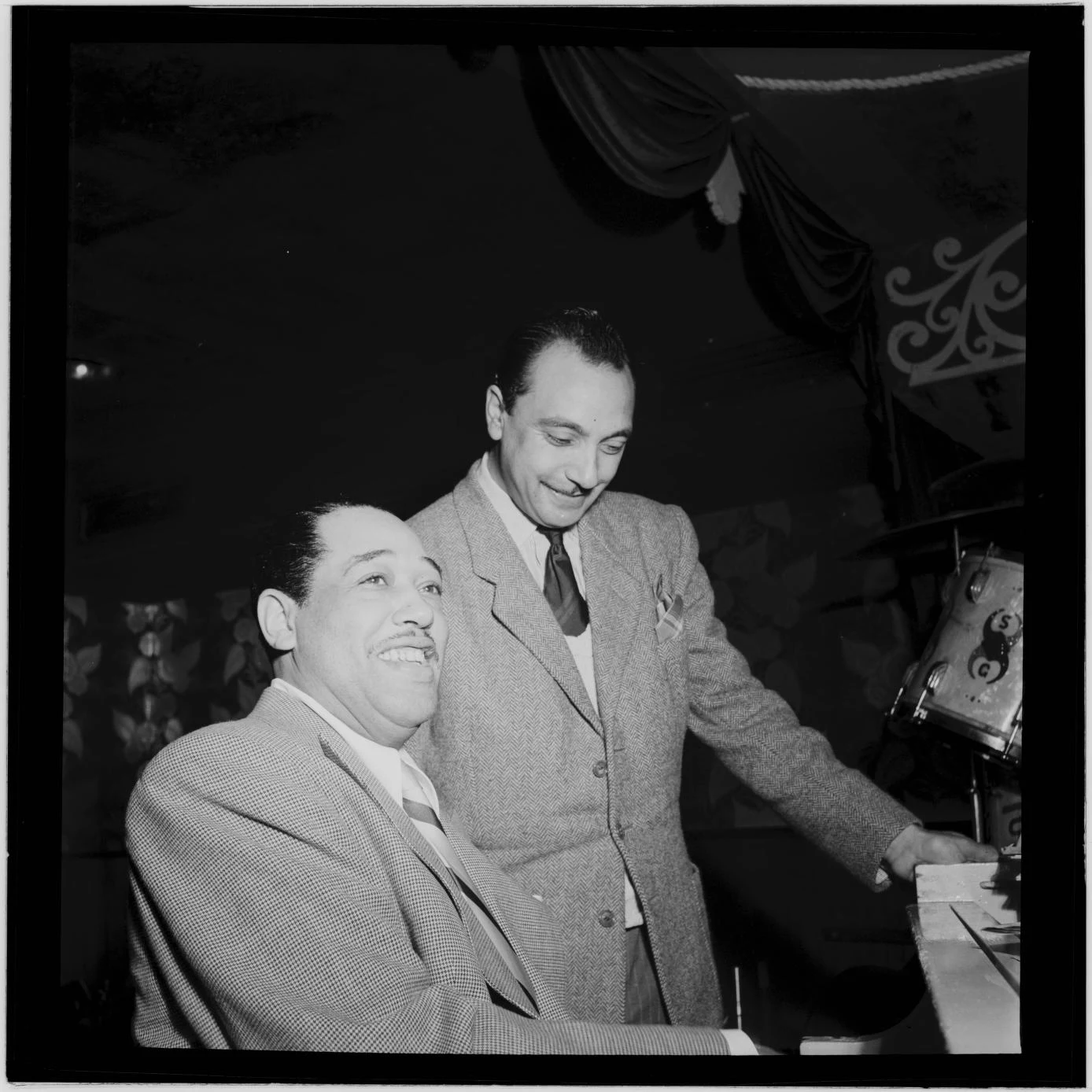
Django, Marcel Cerdan and a concert that had already started
On the second Carnegie Hall night, November 24, 1946, Django was supposed to perform with Ellington.
He was not there.
According to Charles Delaunay's account, Django had encountered French boxing star Marcel Cerdan in New York. The two spent time together talking and drinking until Django suddenly remembered that he was supposed to be somewhere else.
Somewhere rather important.
Later reconstructions differ over exactly how the remaining journey unfolded, but the broad story appears in several accounts: Django arrived extremely late, without his own guitar, while Ellington had already been forced to adapt the programme.
Around eleven o'clock Django finally appeared.
A guitar was found.
He played.
And according to contemporary recollections, the response was enormous.
Duke Ellington apparently did not allow the episode to erase his admiration for Django. He later remembered Reinhardt as one of those rare musicians whose musical personality could not simply be imitated.
America also confronted him with a new kind of jazz
Django did not spend the final years of his life endlessly recreating the sound of the 1930s.
Jazz had changed.
Charlie Parker, Dizzy Gillespie and the musicians associated with bebop were creating a language that sounded startlingly modern even to established jazz players.
When Django first heard the new style, Charles Delaunay remembered his astonished reaction:
But surprise did not turn into rejection.
Django listened.
His later recordings reveal modern harmonic and melodic ideas entering his playing. By the early 1950s he was performing at the Club Saint-Germain with younger French musicians strongly influenced by bebop.
This matters because the image of Django can easily become frozen around Minor Swing, acoustic Selmer guitars and the pre-war Quintette.
Django himself wasn't frozen there.
He kept listening.
The guitarist was also a painter
Music was not Django's only creative outlet.
He painted.
Surviving works and contemporary recollections show that painting became increasingly important to him, particularly in periods when he withdrew from regular professional playing.
The dream associated with Manoir de mes rêves is particularly revealing because it appears to cross from one medium into another: music, a larger imagined composition and visual art.
That connection feels important.
Django was not simply a guitarist who occasionally painted.
The stories suggest somebody whose imagination did not particularly care which medium it happened to be using.
Samois: fishing, billiards and a quieter life
In 1951 Django settled with his family in Samois-sur-Seine, near Fontainebleau.
The pace changed.
He continued to perform and record, particularly with younger modern jazz musicians, but family life, painting, fishing and billiards increasingly occupied his time.
It is a strangely fitting final setting for someone who had spent so much of his life escaping schedules.
Not a grand musical capital.
A village beside a river.
Django Reinhardt died on May 16, 1953, aged just 43.
His final recording sessions had taken place only weeks earlier.
Forty-three years is an extraordinarily short life for someone whose influence has lasted so long.
More than a collection of extraordinary stories
There is a risk in telling stories like these.
An eccentric anecdote is easier to remember than a musical achievement. Django can quickly turn into a collection of colourful stories: the red socks, the monkey, the billiard table, the missing guitar, the late arrival.
But those details matter for another reason.
They remind us that one of the defining musicians of twentieth-century jazz did not emerge from the traditional machinery of musical education.
He did not read music in the conventional way.
A devastating injury forced him to reinvent his technique.
He moved between Manouche life and the most fashionable rooms in Europe without completely surrendering himself to either world.
He listened to American swing, made something distinctly his own from it, and then - when a new generation invented bebop - listened again.
Perhaps that is the thread connecting all these stories.
The same quality can be heard in his solos.
They respect the song.
But they never sound as though anyone has told them exactly where they have to go.
Explore Django Reinhardt on Manouke
Listen to the music behind the stories, explore the harmony and play the songs yourself.
Sources and further reading
Many of the personal stories in this article survive through recollections by Stéphane Grappelli, Charles Delaunay and other musicians who knew Django Reinhardt. As with any oral history, some details vary between versions.
- Library of Congress - William P. Gottlieb photograph of Django Reinhardt, 1946
- Library of Congress - Django Reinhardt and Duke Ellington, New York, 1946
- Philharmonie de Paris - Django Reinhardt, Swing de Paris
- Philharmonie de Paris - Nuages
- The New Yorker - Seeing Music
- Vintage Guitar - Django Reinhardt
- Hot Club - Django Reinhardt biographical material